BIO:
WANG Chen (b. 1991, Hohhot, China) is an artist working across digital video, performance, sculpture, drawing, costume fabrication, and sound. Their work constructs spaces where physical labor and digital image-making collide, populated by hybrid beings that resist resolution and held together by friction rather than coherence.
Wang holds a BFA in Painting and Printmaking from Virginia Commonwealth University (2014) and an MFA in Photography from the Rochester Institute of Technology (2018). Solo exhibitions include Arario Gallery in Shanghai, Fotografiska Museum in Stockholm, Shanghai, and Tallinn, Roswell Museum in New Mexico, Lauren Powell Project in Los Angeles, 212 Photography Festival in Istanbul, and Crosstown Arts in Memphis.
Fellowships and residencies include the New York Foundation for the Arts (Interdisciplinary), MacDowell Fellowship, Roswell Artist in Residency, Golden Foundation, and Vermont Studio Center. They have delivered visiting artist lectures at the University of Pennsylvania, New Mexico State University, Parsons, Bennington College, Cleveland Institute of Art and among others. Wang Chen is represented by Arario Gallery.
STATEMENT:
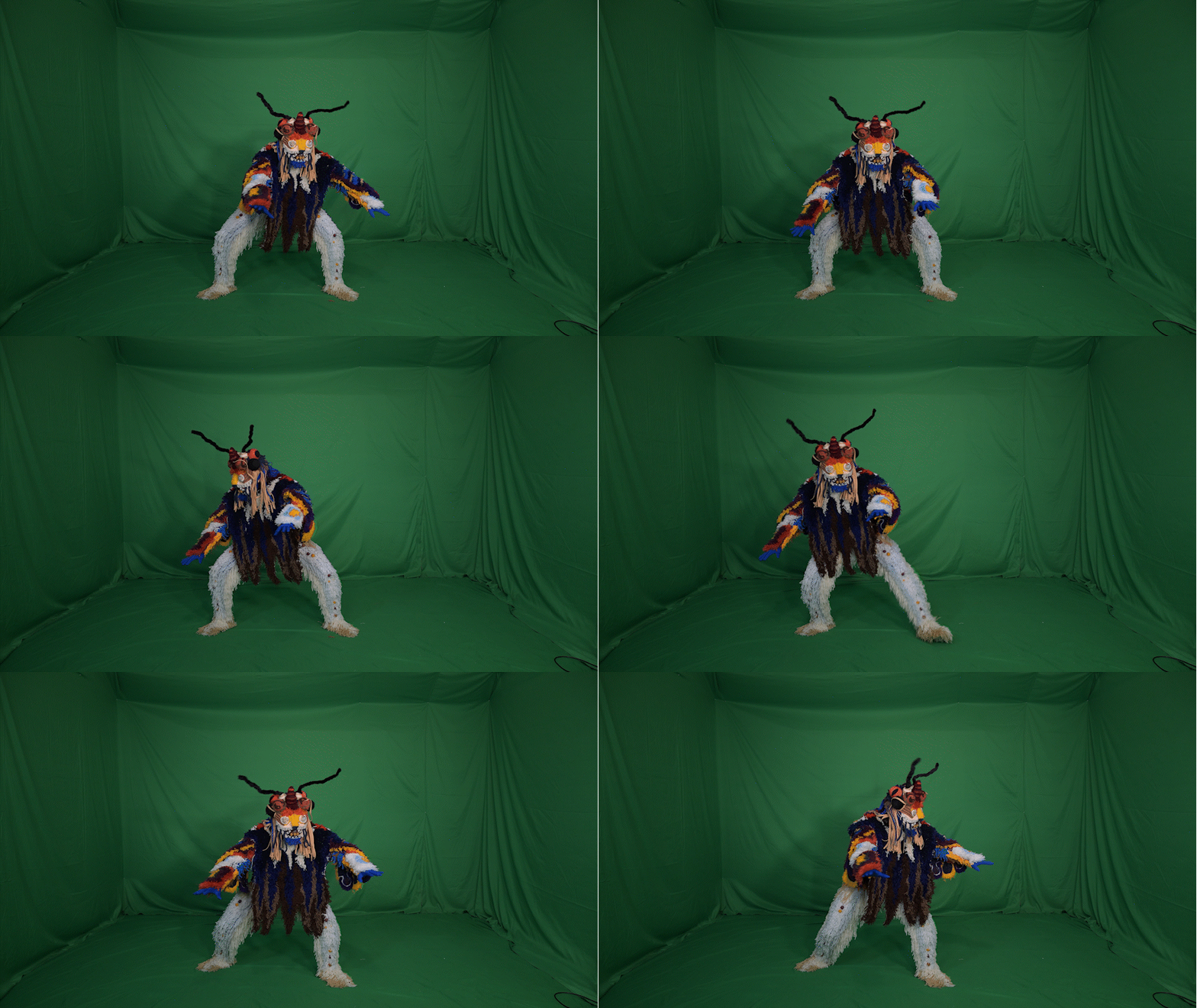
My work arrives as video. It does not begin there. I need room to build costumes, to paint by hand, to perform in front of a green screen inside a space that does not yet exist.
A stable image has already decided what it is. I am more interested in images that are still in the process of becoming. A body in physical space and a world built from scanned drawings do not need to merge smoothly. The friction between them is how the space gets constructed. Every layer is hand-painted, scanned, rebuilt. Thousands of them, placed one by one, until the scene becomes something you can fall into. The digital space erases too easily; the labor is how I push back. Pigment bleeding into paper where I didn't plan it, fabric dragging across a floor that only exists on a screen. These traces resist the lightness that comes with translation. The gap between the performed body and the digital image can stay. What lives inside it has to have weight.
When I perform in front of a green screen, I cannot see myself. I don't know what it looks like. Then I bring that body into the digital space and look again. I see it, but I know that's not me anymore. That's the character.
The space I build is dense, overrun, hard to take in at once. Hybrid beings crowd every layer, not fully human, not fully animal. Figures that mimic the ground until the boundary dissolves. I build illusionary worlds and disappear inside them. What lives there carries histories and desires I don't want to resolve.